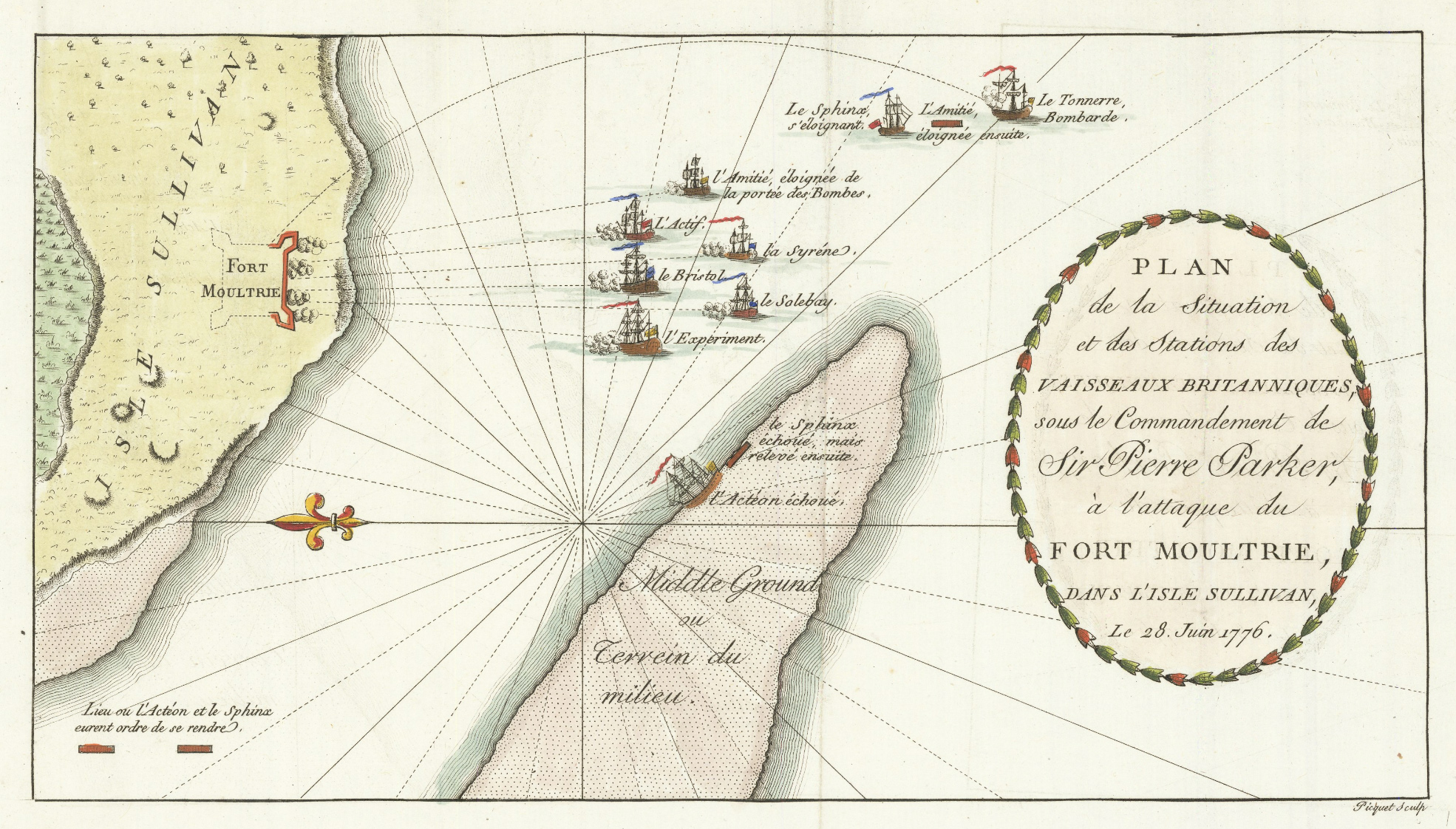
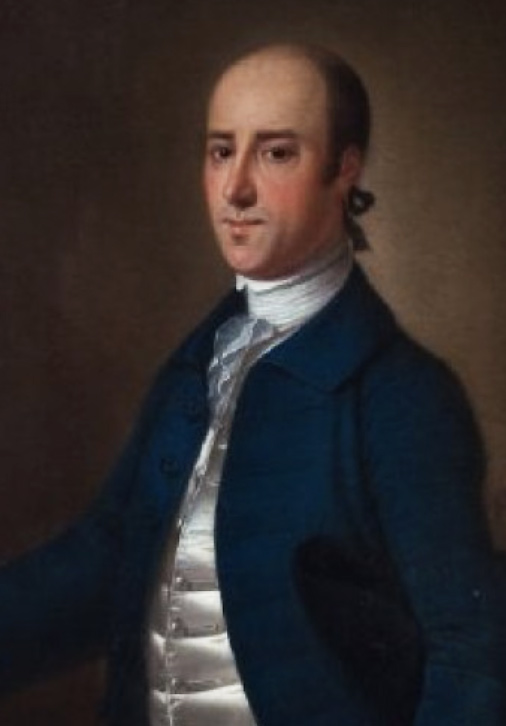
Jan 12-14 Responding to intelligence about a British invasion, the South Carolina Council of Safety orders Colonel William Thomson to send a detachment of ranger volunteers to Sullivan’s Island “for the better securing the possession thereof.” Thomson sends Major James Mayson with seven other officers, 66 enlisted rangers, and 28 prisoners to the island to work on new fortifications.
Jan 18 Christopher Gadsden, delegate to the 2nd Continental Congress, boards the packet Hawke for the trip from Philadelphia to Charleston ∗. Gadsden had been recalled by the South Carolina Provincial Congress so that he could take a leading role in bolstering the coastal defenses against a likely invasion. Gadsden will bring a copy of the newly published pamphlet Common Sense by Thomas Paine. Upon his return, Gadsden takes command of South Carolina’s 1st Regiment.
- Christopher Gadsden and the American Revolution by E Stanley Godbold, Jr and Robert Woody (pg. 147)
Feb 7 President John Rutledge presents to the Provincial Congress a resolution from the Continental Congress requesting that South Carolina adopt a new written constitution. A committee of eleven is duly elected, with Rutledge at its head. This committee is tasked with drafting a new state constitution. This action creates an uproar with a number of elected officials who still seek reconciliation with Great Britain. Aligning himself with the more conservative parts of the Provincial Congress, Rutledge declares that he “stand[s] ready to ride post, by day and by night, to Philadelphia to assist in re-uniting Great Britain and America.”
- Victory on Sullivan’s Island by David Lee Russell (pg. 100)
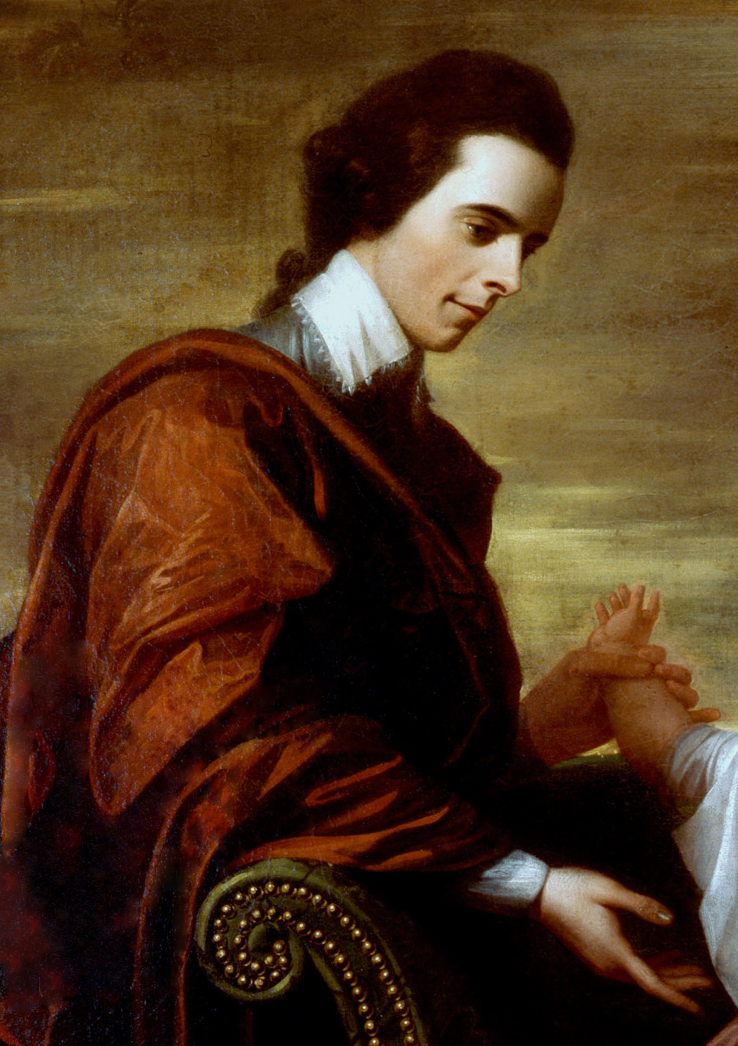
Feb 16 Unable to support the calls for independence, Henry Middleton’s resignation letter reaches Charleston. His son, Arthur Middleton, is elected the following day by the South Carolina Provincial Congress (Feb 17) as a new delegate to the 2nd Continental Congress. Arthur will become one of South Carolina’s four signers later in the year.
- Carolana.com: South Carolina’s Founding Fathers (PDF)
- Middleton Place: Family History
Feb 22 The Second Provincial Congress authorized the formation of the South Carolina 1st Regiment of Riflemen (Col. Isaac Huger). This new regiment will soon be renumbered as the South Carolina 5th Regiment.
Feb 22 Captain Francis Marion is promoted to the rank of major in the 2nd South Carolina Regiment. Marion will later fight at the Battle of Sullivan’s Island and after the capture of Charleston in 1780 a famed militia commander.
Feb 27 Battle of Moore’s Creek Bridge in North Carolina – Patriot forces rout the North Carolina Loyalists. The defeat of the Loyalists in this battle will greatly impact Sir Peter Parker’s decision to redirect his squadron of Royal Navy warships and Clinton’s Redcoats towards Charleston.
- National Park Service: Moore’s Creek National Battlefield
Feb 28 The Second Provincial Congress authorized the formation of the South Carolina 2nd Regiment of Riflemen – (Lt. Col. Thomas Sumter). This new regiment was soon renumbered as the South Carolina 6th Regiment.
Mar 1 The Continental Congress appoints Major General Charles Lee to command the entire southern army. He is held in high esteem for his abilities as a professional soldier.
Mar 2 Under orders from The Council of Safety, Colonel William Moultrie proceeds to Sullivan’s Island and takes command of the force already engaged in building a large fort.
Mar 6 The Second Provincial Congress authorized the printing of £750,000 in Bills of Credit. Within this new set of currency designs, the backs of the £50 and £100 notes included the motto Deus Pugnavit Et Dissipantur – “God has fought, and the opposition was dispersed.”
- SC250 Charleston: South Carolina’s Revolutionary War Paper Money
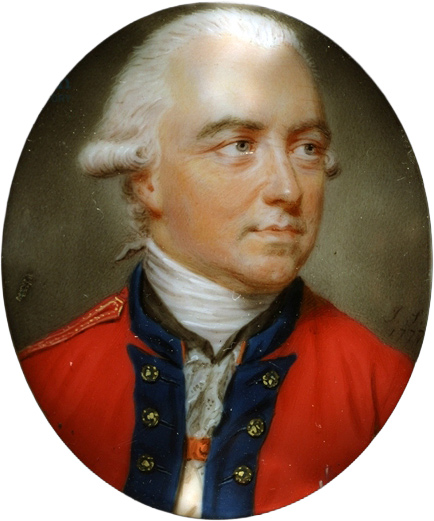
Mar 12 Major General Henry Clinton has been named commander for the British Southern Expedition. This is his first major command and his first time sharing command with a naval officer.
Mar 15 The Royal Navy frigate Syren captures an American ship outside the mouth to Charleston Harbor. The ship was carrying an artillery company from Pennsylvania.
Mar 17 The British evacuate Boston. Captured gunpowder sent by the Patriots in South Carolina had aided General George Washington during the siege.
Mar 22 The South Carolina warship Comet, under the command of Captain Joseph Turpin defeats the Royal Navy warship General Clinton off Cape Fear. This is the first victory of a South Carolina warship over a Royal Navy warship in the war.
Mar 23 Thomas Lynch Jr., is elected to replace his ailing father as one of South Carolina’s delegates to the 2nd Continental Congress. He will later sign the Declaration as one of four South Carolina signers.
- Carolana.com: South Carolina’s Founding Fathers (PDF)
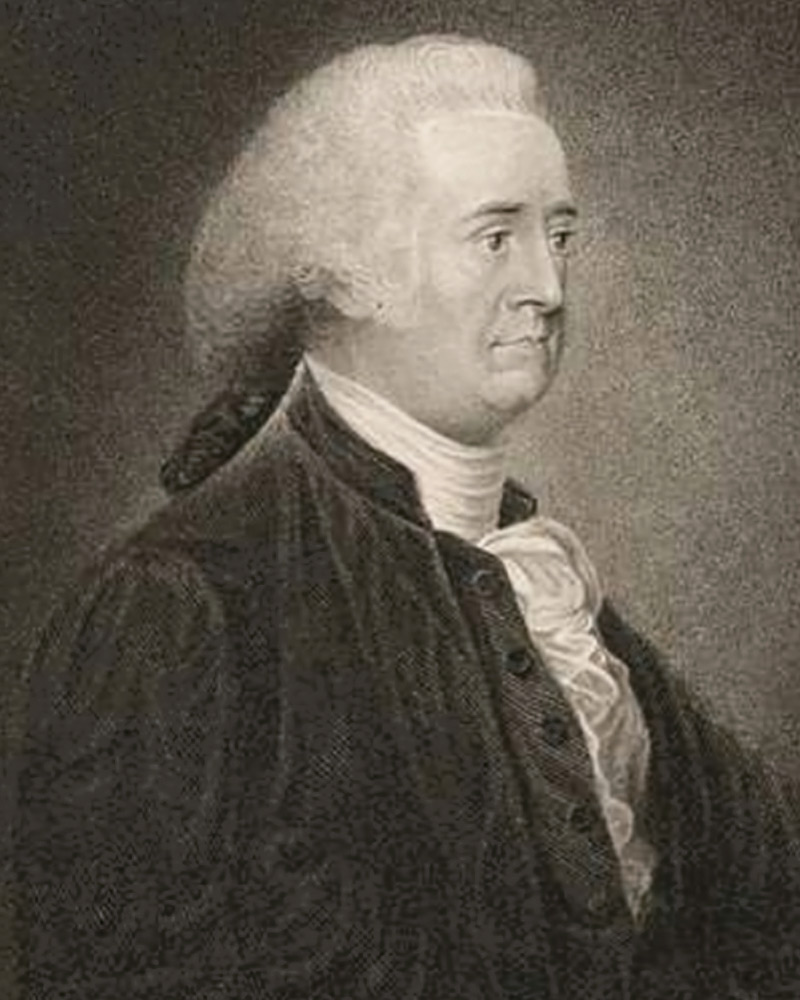
Mar 26 South Carolina adopts its first state constitution, John Rutledge is elected President, Henry Laurens Vice-President, William Henry Drayton Chief Justice. William Moultrie and William Thomson are members of the congress and will continue to serve as it is renamed the General Assembly. Charleston becomes the official capital of the new state. South Carolina becomes the second colony to write and adopt an independent constitution (New Hampshire first). This first constitution is considered a temporary system of government “until an accommodation of the differences between Great-Britain and America shall take place.”
- President – John Rutledge
- Vice-President – Henry Laurens
- Chief Justice – William Henry Drayton
- Assistant Judges – Thomas Bee, John Matthews, Henry Pendleton
- Attorney-General – Alexander Moultrie
- Secretary – John Huger
- Ordinary – William Burrows
- Judge of the Admiralty – Hugh Rutledge
- Register of Mesne Conveyances – George Sheed
- Privy Council – James Parsons, William Henry Drayton, John Edwards, Charles Pinckney, Thomas Ferguson, Rawlins Lowndes
- Legislative Council – Thomas Bee, Stephen Bull, Thomas Ferguson, LeRoy Hammond, Joseph Kershaw, Rawlins Lowndes, Henry Middleton, William Moultrie, David Oliphant, Charles Pinckney, George Gabriel Powell, Richard Richardson, Thomas Shubrick.
Consource.org: South Carolina State Constitution (1776)
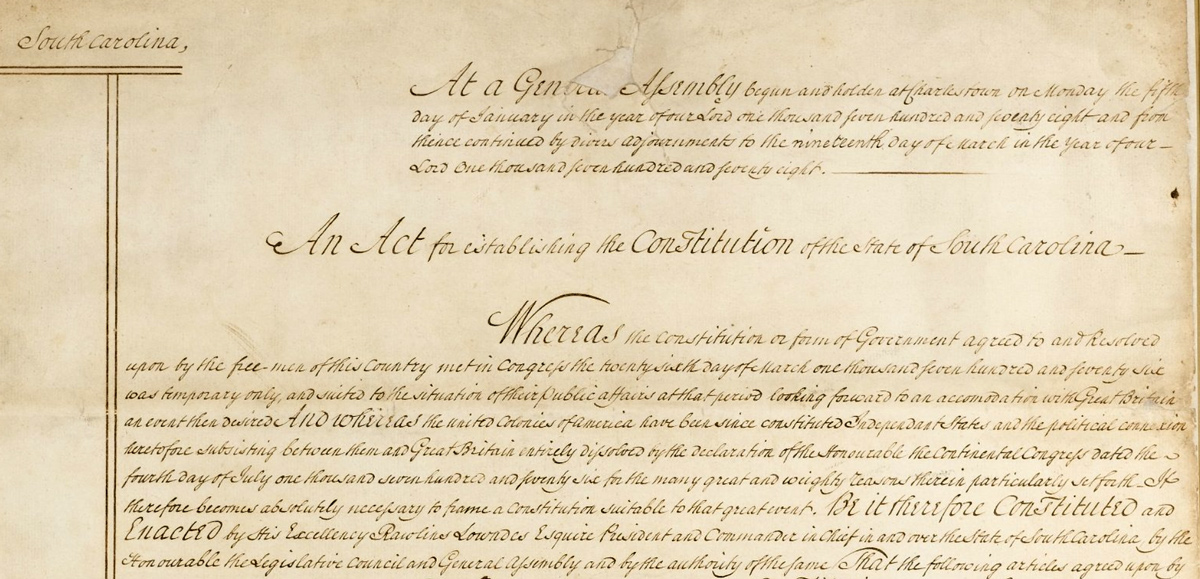
Apr 22 News of South Carolina’s new constitution reaches Philadelphia. John Adams writes that “The news from South Carolina has aroused and animated all the continent. It has spread a visible joy…..”
May The South Carolina delegates in Philadelphia receive instructions from the General Assembly that authorize the delegates to agree with any provision that the majority of Congress believed to be “necessary, for the defense, security, or welfare of this colony in particular, and of America in general.” This directive will encourage the more conservative South Carolina delegates to support the growing calls for independence.
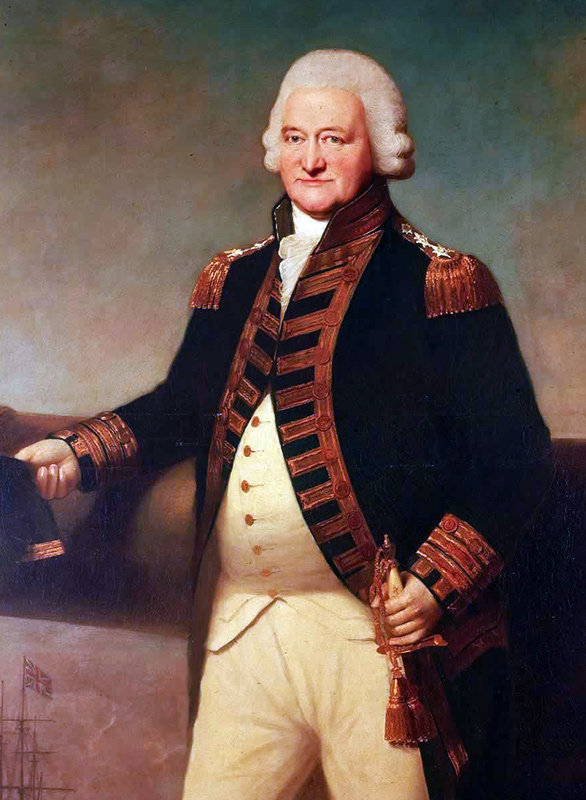
May 1-3 Commodore Sir Peter Parker’s fleet arrives off Cape Fear, five months later than planned. British troops spot Major General Charles Lee as they skirmish with patriots on shore.
May 24-26 Lieutenant Toby Caulfield of the Royal Navy and Captain James Moncrief of Clinton’s engineer corps conduct a daring 48-hour reconnaissance of Charles Town harbor and approaches. They sail from Cape Fear in the schooner Pensacola Packet escorted by the frigate Sphinx. Caulfield sounds the bar and finds it passable by the largest ship, the Bristol, at high tide. Moncrief lands alone at the fort which is under construction on Sullivan’s Island. He talks with a guard, walks around the fortifications and makes a sketch. The patriots do not suspect him of being an enemy until he is leaving. They fire at his boat but he escapes unhurt. On May 26, Moncrief presents an encouraging report to Commodore Parker at Cape Fear. This information is the deciding factor in Parker and Clinton agreeing on the mission to seize Sullivan’s Island.
May 31 The British army and Royal Navy sail from Cape Fear for Charles Town at sunrise. En route, the captain of the sloop Ranger delivers to General Henry Clinton a letter written on March 3 by Lord George Germain, British Secretary of State for the American Department. Clinton infers that he should return to New York if he determines that “nothing could be soon effected which would be of real and substantial service and advantage, or that making any attempt would expose the troops to great loss from the season being too far advanced and that there should be a hazard of disappointing his service to the Northward …” Clinton confers with his generals and decides to continue towards Charleston, as the Sullivan’s Island mission is consistent with this guidance.
May 31 Commodore Sir Peter Parker’s warships are spotted near Dewees Island, sending Charleston into wild confusion. An attack is expected within a few days. Express riders are dispatched to all parts of the province with the call for militia. Troops pour into the city as refugees evacuate. Lead weights are removed from windows to be cast into musket balls. Barricades are erected on principal streets and small fortifications are thrown up wherever the British might disembark. The printing presses and public records are relocated to places of safety. President John Rutledge even requests that gambling and horse racing be suspended. In a dramatic and expensive move, stores and buildings on the wharves are torn down to clear fields of fire.
Jun 1-4 The Royal Navy fleet is at anchor near Bull’s Bay, twenty miles from Charleston. South Carolina’s exiled Royal Governor William Campbell is with the expedition and provides recommendations about how to capture Sullivan’s Island. He concludes, “Two battalions of infantry and a detachment of artillery would be sufficient to hold Charleston if supported by two frigates in the harbor.”
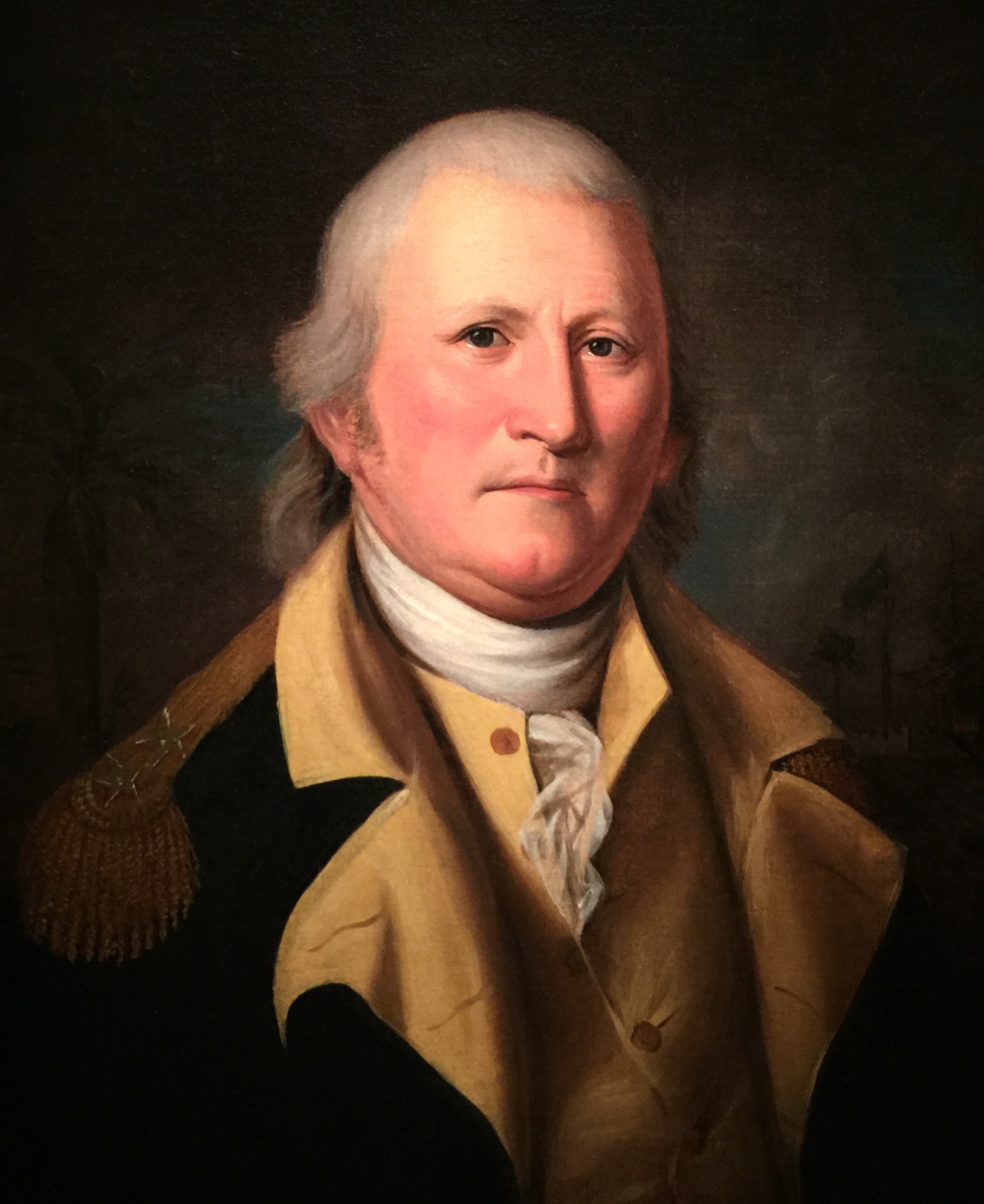
Jun 3 Colonel William Moultrie reports to President Rutledge that a British ship has been busy sounding the inlet at the Advance Guard and along Long Island. “It seems as though they intended a descent somewhere hereabout.”
Jun 4 The British squadron anchors off the Charleston Bar
Jun 4 Maj. General Charles Lee arrives at Haddrell’s Point before journeying on to Charleston. Lee begins inspecting the local defenses, while cursing loudly. Patriot morale is boosted by his arrival and reputation.
- Crescent Moon Over Carolina by Bragg (pg. 54)
Jun 6 Major General Henry Clinton issues a proclamation to the inhabitants of Charleston demanding submission to the Crown. It is ignored by the patriots.
- Victory on Sullivan’s Island by David Lee Russell (pg. 175)
Jun 9 President Rutledge announces that General Charles Lee is in command of all troops in South Carolina to avoid any conflict over authority in the campaign.
Jun 10 Captain Ferdinand de Brahm, the engineer of Fort Sullivan, is sent to the northeast point of Sullivan’s Island to build breastworks of palmetto logs that will guard Breach Inlet.
Jun 14 Major General Henry Clinton and Lord Charles Cornwallis arrive on Long Island (Isle of Palms).
Jun 16 The privateer Polly, commanded by Captain Francis Morgan, tries to sail past a gauntlet of British warships and into Charleston Harbor. The Polly was carrying a cargo of 300 barrels of gunpowder, 20 chests of cartridges, several hundred stands of arms, 90 barrels of rum, sugar, and gin from St. Eustatia. The Polly ran aground near Stono Creek and that night the Patriots scuttled and abandoned her. The Bristol sent eight boats under the command of Lt. Molloy to investigate and attempt to refloat the Polly, but she had five feet of water in her hold. So, they set her on fire, and she “blew up with a great Explosion… It would have been much greater but she had five feet of water in her hold, which had damaged a great deal of the Powder.”
Jun 16-18 Over three days, the British army troops and their gear are transported by small boats onto the northern part of Long Island (Isle of Palms) through heavy surf. Some have to swim to shore. A few recruits are left aboard transport vessels to confuse the patriots. Colonel William Thomson is now in command of the patriot Advanced Guard at the Breach. He observes the landing through his glass, noting that they were landing “as fast as the boats can bring them.” More than 2,000 British soldiers encamp in an area 1¼ miles long and 300-400 yards wide.

Jun 17 After a personal reconnaissance, General Henry Clinton concludes that Breach Inlet cannot be crossed on foot at low tide and notifies Commodore Sir Peter Parker. He says, “This of course rendered it impractical for the army to take the share in the attack of the fort on Sullivan’s Island which had been at first intended.” Till this point the British believed that the British soldiers could ford Breach Inlet on foot and attack the unfinished fort on Sullivan’s Island from the rear. This intelligence failure will play a significant part in the upcoming Battle of Sullivan’s Island.
Jun 18 The first battlefield casualty of the Battle of Sullivan’s Island occurs on or about this day. Patriot leader Richard Hutson later writes to Captain Isaac Hayne from Fort Johnson, “On their sending their first reconnoitering party upon Long Island, one of their men was shot by one of our Riflemen. He was dressed in Red laced with Black and had a Cockade & Feather in his Hat, & a sword by his side. By which it appears that he was an Officer; but that is all we know about him.”
Jun 18 and 24 The Continental Congress passed resolutions which put six South Carolina State Regiments upon the Continental Establishment, bringing in the youngest officers of their respective ranks. It took the South Carolina legislature until September 20th to pass an Act acquiescing to the demands of the Continental Congress.
Jun 20 Major General Charles Lee exhorts the people of Charleston to prepare for the British attack. His orders of the day state “True soldiers and magnanimous citizens must brandish the pick axe and spade as well as the sword, in defence of their country.”
Jun 26 The Royal Navy warship Experiment crosses the Charleston Bar – the last of the nine major combatants Parker will use in his attack on the fort on Sullivan’s Island.
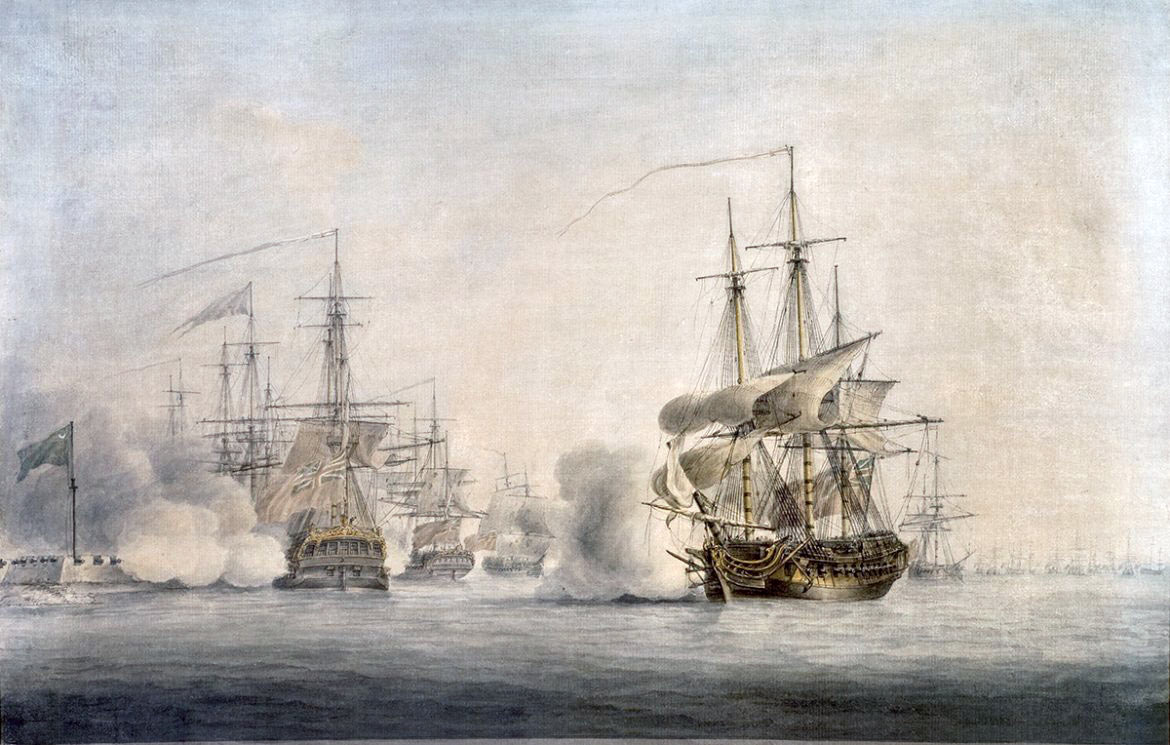
Jun 28 The Battle of Sullivan’s Island
- Video: The Battle of Sullivan’s Island
- Top 10 Facts: The Battle of Sullivan’s Island

Jun 30 Mrs. Susannah Elliot and other ladies from Charleston present the 2nd South Carolina regiment with two embroidered silk regimental flags – one red, one blue. They bear the regiment’s motto: “Vita Potior Libertas” (Liberty Rather than Life) and the year 1775.
- South Carolina State Flag Study Commission (PDF)
- Crescent Moon over Carolina: William Moultrie & American Liberty by C.L. Bragg
Jul 1 Major General Charles Lee writes to General George Washington about the battle for “…the Town which on my arrival was utterly defenceless.”
- National Archives: Read the Letter
Jul 2 South Carolina’s delegates in Philadelphia join the others to vote for the approval of the Declaration of Independence. Edward Rutledge later writes that “we must bid adieu…to Ease, and Happiness. We launch as it were into an unknown Ocean.”
Jul 4 President John Rutledge and Maj. General Charles Lee visit the garrison on Sullivan’s Island. They promote William Moultrie to the rank of Brigadier General. Rutledge offers his sword and an officer commission to Sgt. William Jasper, but he declined both on the account of his being illiterate.
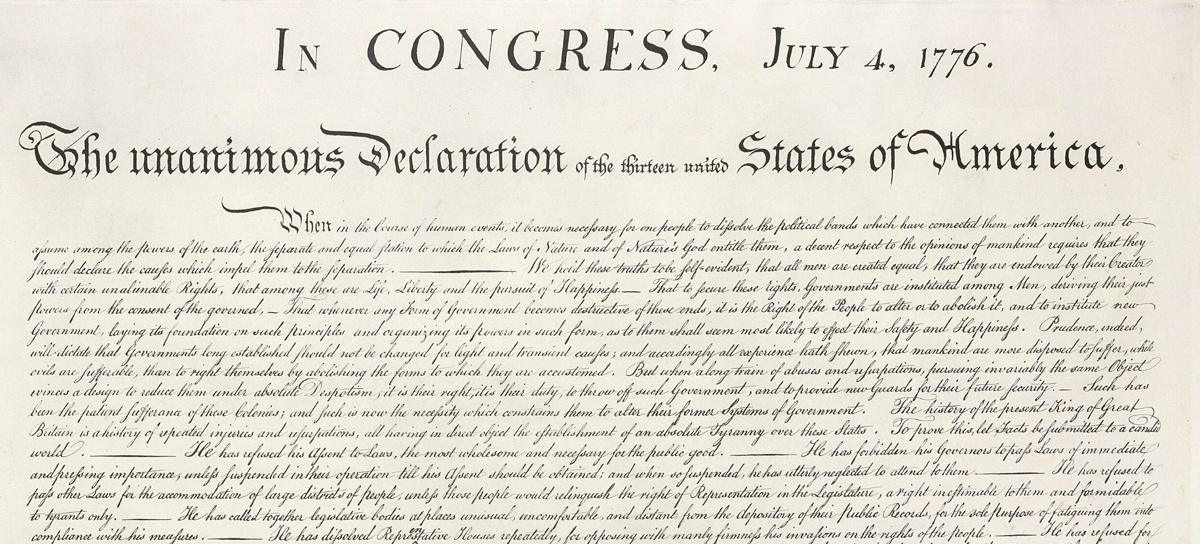
Jul 4 Declaration of Independence made public in Philadelphia
Jul 20 The Continental Congress passes a resolution commending General Lee, Colonel Moultrie, Colonel Thomson and their officers and men for their victory in the Battle of Sullivan’s Island.
Jul 20-26 Maj. General Henry Clinton and most of the British troops from Long Island (Isle of Palms) sail for New York.
Jul 21-22 The last British transport ship to leave is the Glasgow Packet, which grounds crossing the bar at Spencer’s Inlet and is captured by a patriot row galley mounting an 18-pounder and some smaller guns. Patriot Captain William Pickering, Cornelius and William Dewees, and 21 volunteer seamen man the galley. About 30 British officers and men and 43 Highlanders are taken prisoner. Highlander Captain Campbell and nine crewmen escape in a longboat. The patriots strip and burn the ship, which is the fourth British ship lost in the Battle of Sullivan’s Island.
- Carolana.com: Spencer’s Inlet
Aug 1 Francis Salvador dies from his wounds suffered in a July 31st ambush by Loyalist forces and Cherokee near the Keowee River. Salvador was shot in the battle and fell into the bushes and was later scalped. Salvador is considered the first Patriot of Jewish descent killed in the American Revolution. In January of 1775, Salvador had been elected to the South Carolina Provincial Congress, making him also the first Jewish person elected to political office in the thirteen American colonies.
Williamson recounted approaching Salvador after the battle: “When I came up to him after dislodging the enemy and speaking to him, he asked whether I had beaten the enemy. I told him ‘Yes.’ He said he was glad of it and shook me by the hand and bade me farewell, and said he would die in a few minutes”
- Library of Congress: Francis Salvador
- SC Encyclopedia: Francis Salvador

Aug 2 South Carolina’s four delegates affix their signatures to the Declaration of Independence in Philadelphia. One of the delegates (Lynch) will be lost at sea during a subsequent voyage, and two (Edward Rutledge and Thomas Heyward Jr.) will be captured by the British after Charleston’s surrender in May of 1780.
Aug 2 An express from the Continental Congress arrives in Charleston with accounts that “on the 4th day of July, that body, had declared the United Colonies, Free and Independent States.” Many of Charleston’s inhabitants are overcome with joy as the city celebrates with bonfires and impromptu parades.
Aug 2-3 The last of Sir Peter Parker‘s warships sails away. Parker soon arrives in New York, where local patriots had penned a verse for him: “Now bold as a Turk, I proceed to New York, Where with Clinton and Howe you may find me. I’ve the wind in my tail and am hoisting my sail, To leave Sullivan’s Island behind me.”
For the first time in two months, Charleston’s coast is clear. As the British move north, they allegedly ravage the coastline, taking at least 50 slaves from outlying plantations. The last ship to leave, the Active, lands at Thomas Shubrick’s plantation on Bull’s Island. A force of “40 White and 20 black men” seized livestock and provisions. Six enslaved people will also escape on board the British ships.
Aug 5 The first public recitation of the Declaration of Independence in South Carolina occurs near the South Carolina State House. At noon on August 5, the Charleston Regiment of Militia paraded under arms along Broad Street. At 12:45 p.m., South Carolina president John Rutledge, accompanied by Major General Charles Lee, Brigadiers Robert Howe and John Armstrong, members of the Privy and Legislative Councils, the House of Representatives, and Continental Army officers, processed to the west end of Broad Street to attend the public reading of the Declaration of Independence.
At approximately 1:30 p.m., the Declaration was carried to the west side of the Exchange building and read a second time, accompanied by public acclamations and cannon fire from Granville’s and Broughton’s Bastions. Hundreds of spectators filled East Bay Street and gathered around the Exchange.
A third reading occurred on the town’s north side beneath a large live oak known as the Liberty Tree, described as standing in Mr. Mazyck’s pasture near present-day Charlotte and Alexander Streets.
- Charleston Time Machine: Declaring Independence in 1776 Charleston
Aug 21 King George III writes to Lord Sandwich expressing his disappointment. “… the attack upon Charles Town has not been crowned with success, …perhaps I should have been as well pleased if it had not been undertaken.”
Aug 24 The London Gazette publishes excerpts of Parker’s and Clinton’s accounts of the Battle of Sullivan’s Island. Parker’s account says that on the afternoon of June 28th, “…the Fort was then totally silenced, and evacuated for near one Hour and a half: but the Rebels, finding that our Army could not take possession, about Six o’Clock a considerable Body of People re-entered the Fort and resumed firing … The Lordships will see plainly by this Account, that if the Troops could have cooperated in this attack, His Majesty would have been in Possession of Sulivan’s Island.” Henry Clinton will take great offense to this claim.
Aug 27 The Battle of Long Island, NY
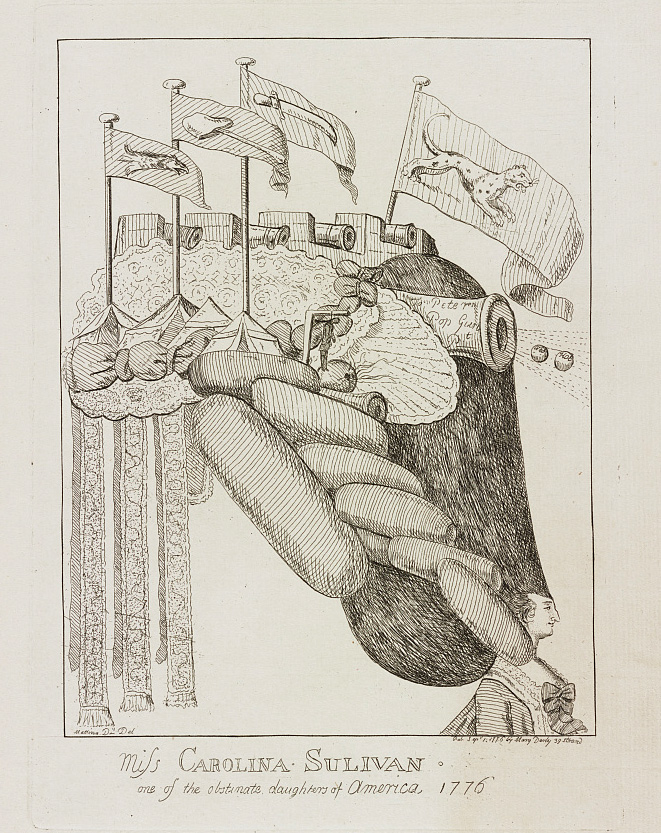 Sep 1 Matthew and Mary Darly publish a satirical cartoon in London, entitled “Miss Carolina Sulivan, one of the obstinate daughters of America, 1776”. This cartoon, featuring a woman with a fantastic tower of hair, is the latest in a series highlighting embarrassing military setbacks in America.
- SC250Charleston: Miss Carolina Sulivan
Sep 20 The South Carolina General Assembly convenes at the State House and officially embraces the Declaration of Independence. On September 20th, they addressed President Rutledge in the following carefully selected words: “It is with unspeakable pleasure we embrace this opportunity of expressing our satisfaction in the Declaration of the Continental Congress, constituting the United Colonies free and independent States, absolved from allegiance to the British Crown and totally dissolving all political union between them and Great Britain, an event unsought for and now produced by unavoidable necessity, and which every friend to justice and humanity must not only hold justifiable as the natural effect of unmerited persecution, but equally rejoice in, as the only effectual security against injuries and oppressions and the most promising source of future liberty and safety.”
Oct The new state government meets in Charleston (Old Exchange) to address defensive needs and funding.
Oct 19 The South Carolina General Assembly approves the issuance of $80,000 in new Bills of Credit, the first paper currency denominated in dollars. Affirming South Carolina’s independence, this new currency also has printed on each bill “The State of South Carolina.”
- The Early Paper Money of America by Eric Newman (PDF)

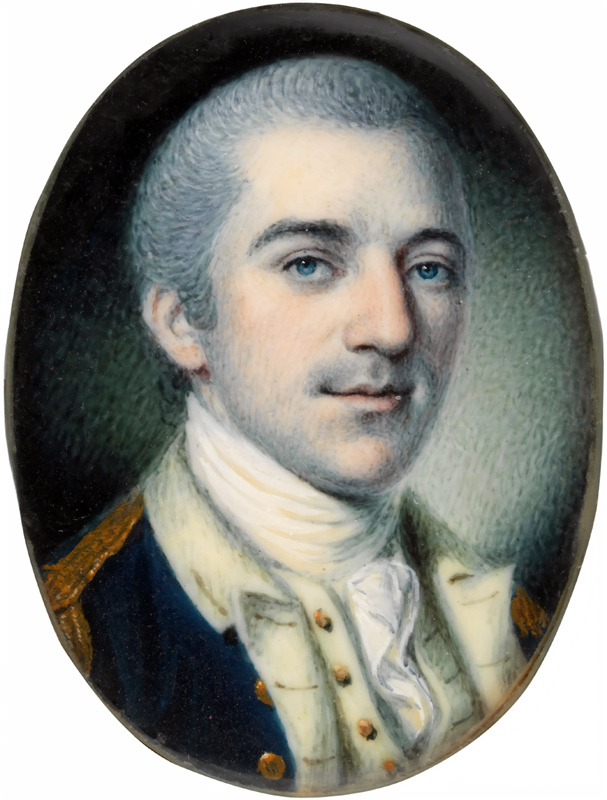
Oct 26 John Laurens, writes a letter to his father, Henry Laurens, discussing his evolving anti-slavery views. This letter highlights the ongoing, though minority, debate about slavery among some individuals during the war. Laurens will join General George Washington’s staff as an aide in 1777.
Nov The Second South Carolina General Assembly convened between November of 1776 and October of 1778 in two regular sessions plus four special sessions, but there are no extant records of most of their accomplishments.
Dec 25-26 George Washington’s army crosses the Delaware River and defeats a Hessian outpost at the Battle of Trenton
________
* In 1776, Charleston was called “Charles Town” or “Charlestown”. We have used the modern spelling here to avoid confusion.